
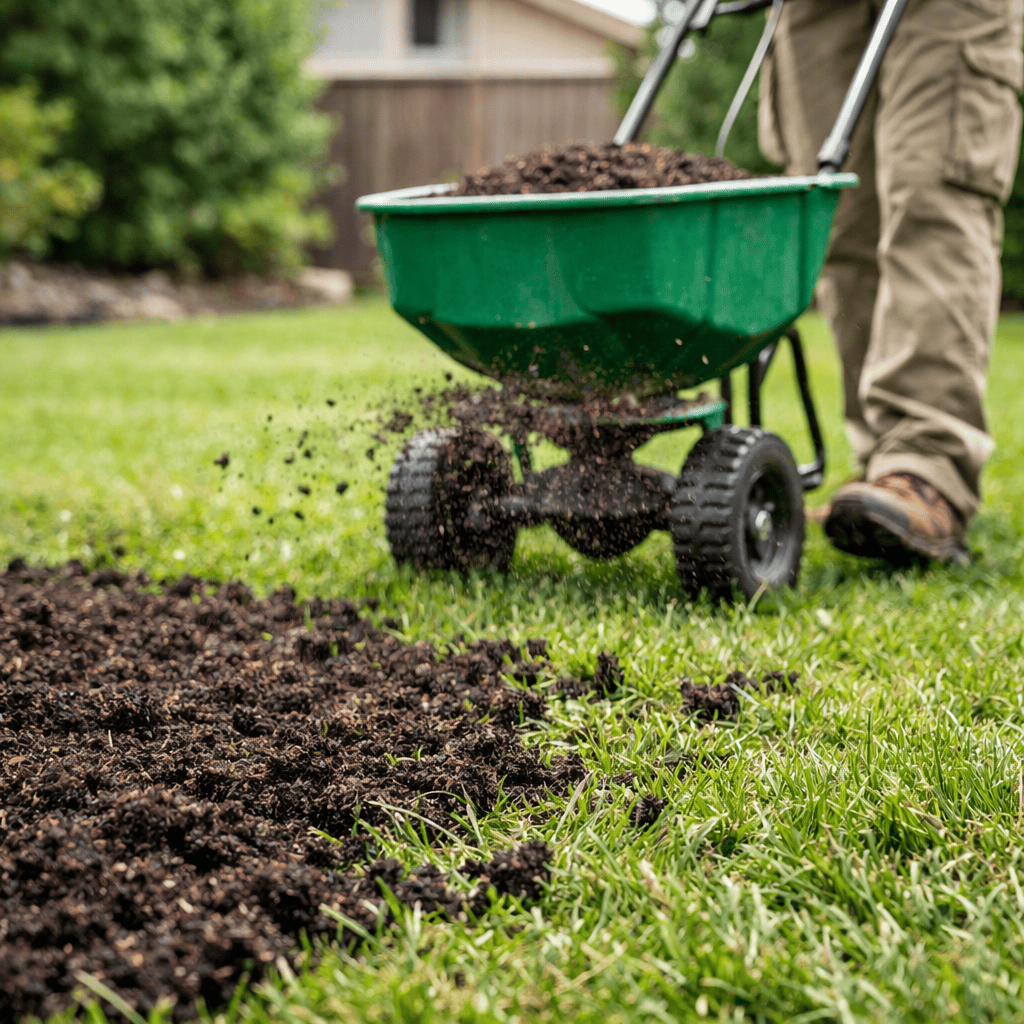

Compost topdressing works best in soils that benefit from improved structure, organic matter, and biological activity, including compacted clay, sandy soils, and nutrient-depleted lawns. It helps balance moisture retention and drainage while supporting healthier turf growth. In areas like Omaha, Nebraska, where soil conditions often vary, understanding your soil type can help explain how compost interacts with your lawn over time.
Why Soil Type Matters for Compost Topdressing
Soil type influences how water, nutrients, and air move through the ground, which directly affects lawn health. Compost topdressing is often used to improve these conditions by adding organic matter and encouraging microbial activity. However, different soil types respond in different ways.
Some soils naturally hold too much water, while others drain too quickly. Compost helps bring these extremes closer to balance by improving soil structure. This makes it easier for grass roots to grow deeper and access nutrients more consistently.
Clay Soils and Compost Topdressing
Clay soil is common throughout Omaha and surrounding areas and is known for being dense and compacted. It tends to hold water longer than needed, which can limit oxygen availability for roots.
Compost topdressing can help loosen clay soil over time by introducing organic matter that improves aggregation. This creates small pockets within the soil that allow better airflow and drainage. As microbial activity increases, the soil gradually becomes more workable and supportive of turf growth.
Because clay soils change slowly, improvements happen over multiple applications rather than all at once. The goal is gradual structure improvement rather than immediate transformation.
Sandy Soils and Compost Topdressing
Sandy soils have the opposite challenge of clay. They drain quickly and often struggle to retain nutrients and moisture. This can lead to inconsistent grass growth, especially during hot and dry periods.
Compost topdressing helps sandy soils by increasing their ability to hold water and nutrients. The added organic matter acts like a sponge, slowing down how quickly water moves through the soil. This creates a more stable environment for grass roots.
Over time, sandy soils treated with compost tend to support more consistent turf density and improved resilience during stress periods.
Loamy Soils and Compost Topdressing
Loam is often considered a balanced soil type because it contains a mix of sand, silt, and clay. While loamy soils already have favorable structure, they can still benefit from compost topdressing.
In these soils, compost primarily supports microbial life and nutrient cycling rather than correcting major structural issues. It helps maintain soil health and prevents gradual decline over time.
Even in well-balanced soils, organic matter breaks down naturally, so replenishing it periodically helps sustain long-term lawn performance.
Compacted Soils and Low Organic Matter Soils
Some lawns are not defined strictly by soil type but by condition. Compaction and low organic matter are common issues in residential lawns, especially those with frequent foot traffic or construction history.
Compost topdressing is often used to support these soils by introducing biology and helping relieve surface-level compaction over time. It does not mechanically break up deep compaction, but it encourages gradual improvement through natural processes like microbial activity and root growth.
This is particularly relevant in newer developments around Omaha, where soil is often disturbed during construction and may lack organic material.
How Soil Biology Influences Results
Soil is not just a physical structure—it is a living system. Compost introduces beneficial microorganisms that support nutrient cycling, root development, and overall lawn health.
Different soil types support microbial life in different ways. Clay soils may hold microbes well but limit oxygen, while sandy soils allow oxygen but struggle to retain biological activity. Compost helps balance these conditions by improving both habitat and food sources for microbes.
As microbial populations increase, they help break down organic matter into plant-available nutrients, creating a more self-sustaining soil environment over time.
Is Compost Topdressing Only for Poor Soil?
Compost topdressing is not limited to lawns with obvious problems. It is also used as a preventative approach to maintain soil health and support consistent turf growth.
Even lawns that appear healthy may have underlying limitations in organic matter or microbial activity. Adding compost helps reinforce the natural processes that keep soil functioning well.
In regions with seasonal stress, such as hot summers and cold winters in Nebraska, maintaining soil resilience can help lawns recover more effectively between growing seasons.
Can Soil Type Change Over Time with Compost?
Soil type itself does not completely change, but its behavior can shift over time with repeated compost applications. Clay soil may become easier to work with, and sandy soil may begin to retain moisture more effectively.
These changes happen gradually as organic matter accumulates and soil biology becomes more active. The structure improves, even though the original mineral composition remains the same.
This is why compost topdressing is often viewed as a long-term soil improvement strategy rather than a one-time solution.
Choosing the Right Approach for Your Lawn
Understanding your soil type helps set realistic expectations for how compost topdressing will affect your lawn. Each soil responds differently, but the common goal is improving structure, supporting biology, and creating better growing conditions for grass.
Homeowners looking to learn more about how this fits into a broader soil-based approach can explore the concept further through Topdressing with Compost.
Understanding the Best Soil Types for Compost Topdressing
The best soil types for compost topdressing are those that benefit from improved balance—whether that means better drainage in clay soils, better moisture retention in sandy soils, or sustained biological activity in loamy soils. Rather than targeting one specific soil type, compost works by enhancing the natural function of the soil over time.
In areas like Omaha, where soil conditions vary from yard to yard, compost topdressing serves as a flexible way to support long-term lawn health through improved soil structure, organic matter, and microbial activity.